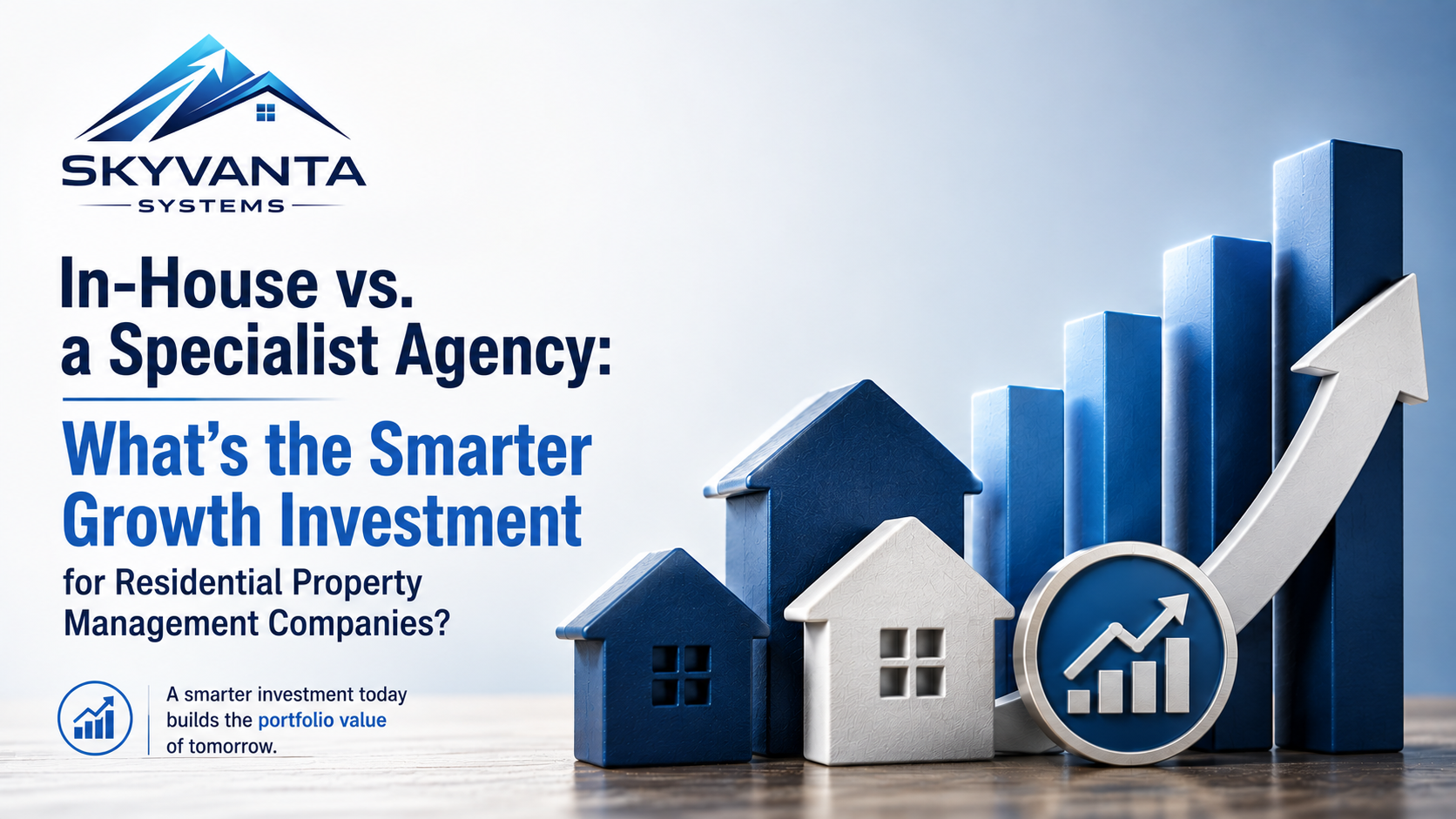
When a residential property management company gets serious about growth, an important decision usually comes up: Do we hire someone in-house, or do we partner with a specialist agency?
I think both options deserve a fair look. Having someone internally who knows your company, your team, and your markets has real advantages. But I also think the true cost and expectations of an internal marketing hire are often underestimated.
If the objective is to consistently get in front of more property owners and investors, you’re asking that person to do much more than simply “handle marketing.”
What Does an In-House Hire Really Cost?
We’ve spent time looking at what a capable internal marketing hire can realistically cost. On average, we estimate base compensation of roughly $75,000–$100,000+ annually for someone experienced enough to take meaningful ownership of growth. Of course, compensation can vary considerably based on the company, geographic market, experience level, and scope of the position.
Salary is only part of the investment. There are payroll taxes, benefits, insurance, paid time off, recruiting, training, and other employer-related expenses. According to the U.S. Bureau of Labor Statistics, benefits accounted for approximately 30% of total private-industry employer compensation costs in early 2026.
Then there are the tools required to execute effectively: SEO platforms, local search software, competitive research, analytics, reporting, website technology, AI tools, and tracking systems. Depending on the operation, we’ve estimated another $8,000–$15,000+ annually for software and technology.
When we modeled these costs together, we arrived at an estimated average annual investment of approximately $95,000–$130,000+ for one capable internal marketing hire. Actual costs can be higher or lower depending on the company, location, compensation structure, benefits, and technology requirements.
That’s where I think the comparison gets interesting. After making that investment, you still have the execution capacity and skill set of one person.
One Person vs. Multiple Areas of Expertise
This isn’t a criticism of internal marketing professionals. It’s a question of capacity and specialization.
Think about what it takes for a residential property management company to compete for owners and investors today: SEO, Google Maps, Google Business Profile management, website optimization, landing pages, conversion strategy, Google Ads, analytics, competitive research, content, AI search visibility, reporting, and ongoing strategy.
Those aren’t simply different tasks. They’re different areas of expertise.
A great SEO professional isn’t automatically a great paid-search specialist. Someone who knows Google Ads isn’t necessarily a web developer. A talented developer may know very little about local search or conversion strategy.
You can find talented generalists, but there’s a difference between understanding several disciplines and having specialists in each. That’s why larger organizations eventually build marketing departments rather than expecting one employee to do everything.
And once you’re talking about multiple internal specialists, you’re no longer comparing a specialist agency with one employee. You’re comparing it with the cost of building and operating an entire department.
Don’t Overlook Ramp-Up and Dependency
There’s another cost that doesn’t always appear on a spreadsheet: time.
Finding the right person can take weeks or months. Once hired, they still need to learn the company, understand the markets and competition, evaluate what’s already being done, learn the technology, develop a strategy, and begin executing it.
Even a fantastic hire doesn’t walk through the door with a complete growth infrastructure already operating.
There’s also dependency. When much of your marketing operation lives with one employee, the company becomes dependent on that person’s knowledge, availability, and capacity. Vacations happen. People get sick. Workloads increase. Employees receive other opportunities and leave.
If that happens, you aren’t simply replacing someone on payroll. You may also lose valuable knowledge about campaigns, systems, strategy, vendors, technology, and previous testing. Then recruiting and onboarding begin again.
Where a Specialist Agency Changes the Equation
This is where I believe the right specialist-agency model becomes compelling.
Instead of expecting one person to handle everything, a specialist agency can provide access to people who focus on different disciplines. The technology, processes, and workflows are already established, and execution isn’t dependent entirely on one person’s workload or availability.
There’s also scalability. A residential property management company focused on one city today may want to expand into two or three tomorrow. That means more competitors, search markets, landing pages, campaigns, and opportunities to manage. Internally, increasing capacity often means hiring additional people. A properly structured specialist team can already have that additional capacity available.
But simply outsourcing everything isn’t necessarily the answer either. Hiring one company for SEO, another for Google Ads, another for your website, and another for social media can leave someone inside your company managing a collection of disconnected vendors.
That’s why I believe specialization and integration both matter. Your website should support your search strategy. Your local visibility should complement organic search. Your advertising should connect with landing pages designed to convert. Everything should work toward the same business objective.
Why Residential Property Management Specialization Matters
I also believe industry specialization matters more than many companies realize.
Residential property management has specific economics. You’re not simply trying to generate a one-time sale. You’re trying to earn the trust of a property owner or investor, secure a management agreement, and potentially retain that relationship for years.
That means growth should be discussed in terms of owners, investors, management agreements, doors under management, recurring revenue, and portfolio growth.
A specialist agency that already understands those economics doesn’t need months to learn why adding another 50 doors matters or why an owner inquiry is fundamentally different from a tenant inquiry.
That industry knowledge matters.
So, Which Model Makes More Sense?
Every residential property management company has different resources, markets, and growth goals, so there isn’t a one-size-fits-all answer. But when I compare the two models, I believe the real question is whether it makes sense to build and maintain all these capabilities internally, given that a specialized team, established infrastructure, and industry expertise are already available externally.
That’s why I think department is the important word in this comparison. One internal marketing hire isn’t really equivalent to a specialist agency. To recreate that model internally, you would need to consider the people, expertise, technology, software, execution capacity, processes, management, and continuity required to support it.
If one capable internal hire alone represents an estimated average annual investment of $95,000–$130,000+, ask what happens when that person can’t cover every discipline. Do you outsource the gaps? Hire additional specialists? Add more software? And what happens when your company expands into additional markets or that employee eventually leaves?
That’s why, for many growing residential property management companies, I believe a specialist-agency model can offer a more efficient, scalable, and lower-risk path to building the growth infrastructure they need without having to build and manage an entire marketing department themselves.
Ultimately, SEO isn’t the goal. Google Ads aren’t the goal. Google Maps rankings and a new website aren’t the goal. They’re tools.
For a residential property management company, the objective is creating more opportunities to add profitable doors to the portfolio.
Every new management agreement can produce recurring revenue, potentially for years. Add 25 doors, then 50, then 100, and you’re no longer simply talking about marketing expenses. You’re talking about infrastructure supporting the growth and long-term value of the company.
That’s why I believe the in-house versus specialist-agency decision should go beyond salary or monthly cost.
Look at the total investment. Look at expertise. Look at capacity. Look at scalability. Look at continuity. And look at whether the people responsible for growth truly understand residential property management.
The smartest growth investment is the model that gives your company the strongest infrastructure to consistently compete for more owners, win more management agreements, and ultimately add more doors.
Written by: Michael Patterson
Founder & CEO, SkyVanta Systems